


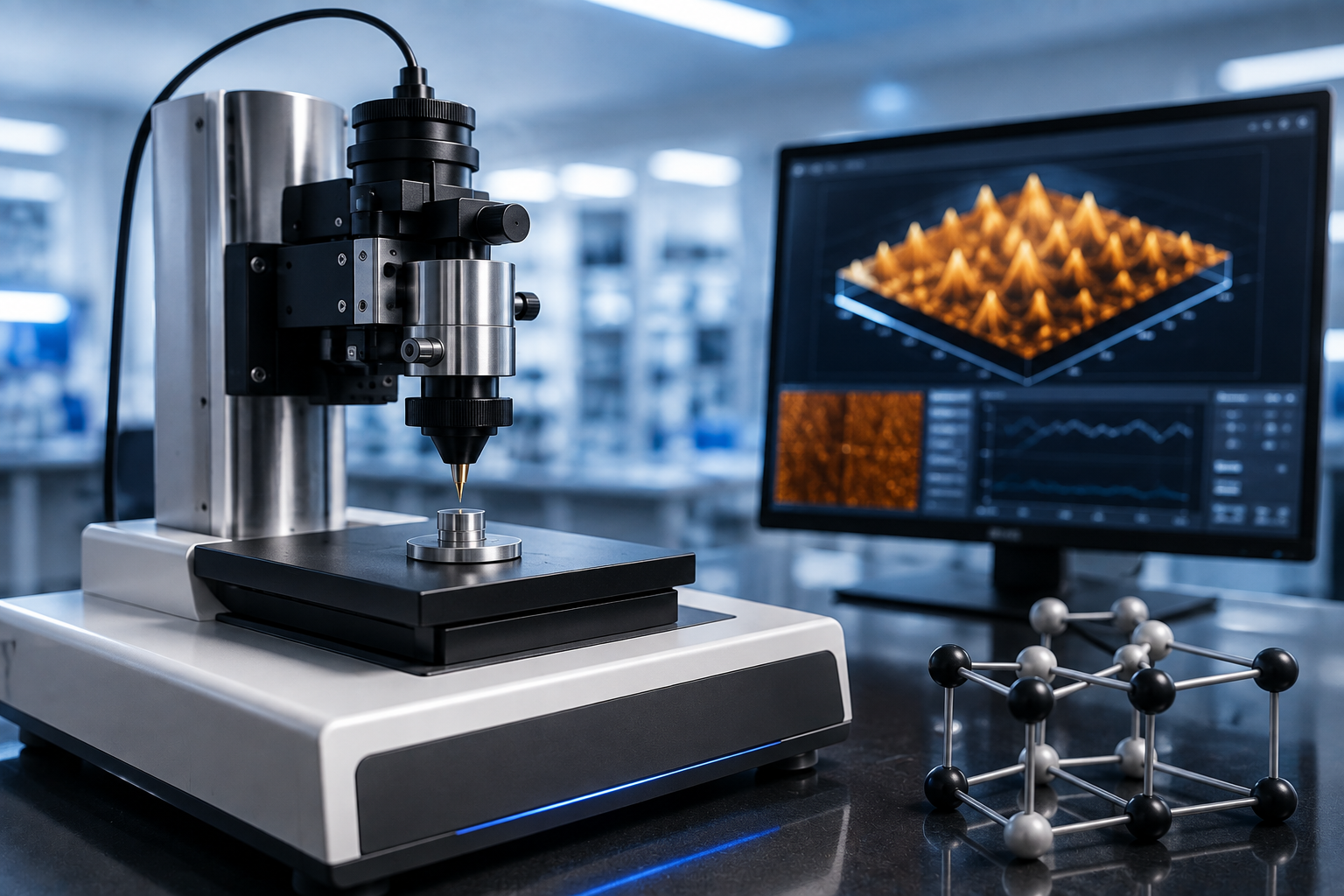
An atomic force microscope typically falls into three broad investment tiers: entry-level research systems for basic imaging, mid-range modular platforms for multi-technique labs, and advanced or custom-built systems for specialized applications like electrochemical or environmental imaging.
The exact figure depends on configuration, accessories, and whether you are buying new or upgrading an existing system. If you manage a lab budget, write a grant proposal, or evaluate capital equipment for a university or R&D facility, you already know that AFM pricing is rarely straightforward. Vendors quote differently, configurations vary widely, and legacy systems complicate the math even further.
This guide breaks down what actually drives atomic force microscope cost, what to budget beyond the sticker price, and how to make a smarter buying decision whether you are purchasing new or extending the life of a system you already own.
What Determines the Cost of an Atomic Force Microscope?
An Atomic Force Microscope is a highly specialized scientific instrument designed to generate nanoscale surface measurements with exceptional precision. Unlike standard laboratory equipment, every AFM can be configured differently depending on research goals.
Several factors influence the overall investment.
Research Application
Different applications require different capabilities.
For example:
- Materials science
- Semiconductor inspection
- Polymer characterization
- Electrochemistry
- Battery research
- Biotechnology
- Life sciences
A laboratory studying biological samples often requires different environmental controls than one analyzing semiconductor wafers.
Choosing features that directly support your research prevents unnecessary spending while ensuring long-term usability.
Imaging Modes
Modern AFMs offer multiple imaging modes.
Common examples include:
- Contact Mode
- Tapping Mode
- Non-Contact Mode
- Conductive AFM
- Magnetic Force Microscopy
- Electrochemical AFM
Additional imaging capabilities increase system flexibility while allowing researchers to expand future projects without replacing the instrument.
Scanner Performance
The precision scanner is one of the most critical components of any AFM.
Its capabilities influence:
- Scan accuracy
- Resolution
- Measurement repeatability
- Sample stability
- Large-area imaging performance
Higher-performance scanners provide greater measurement confidence, especially in demanding research environments where repeatability is essential.
Environmental Control
Many advanced research applications require specialized imaging environments.
Examples include:
- Liquid imaging
- Temperature-controlled experiments
- Humidity control
- Electrochemical cells
- In-situ measurements
These capabilities allow researchers to observe samples under realistic operating conditions, significantly expanding experimental possibilities.
Software and Automation
Modern AFM software plays an important role in productivity.
Advanced software may include:
- Automated image acquisition
- Data processing tools
- Measurement analysis
- Batch scanning
- Report generation
- Remote operation
Researchers managing multiple experiments often benefit from automation that reduces manual adjustments and improves workflow efficiency.
What Are the Different Price Tiers for AFM Systems?
Rather than quoting exact numbers, which vary by configuration and region, it helps to think in tiers:
| Tier | Best For | Typical Configuration |
| Entry-level | Teaching labs, basic surface imaging | Single imaging mode, standard scanner |
| Mid-range | Research labs needing flexibility | Multiple imaging modes, upgradeable modules |
| Advanced/custom | Electrochemistry, biotech, semiconductor research | Environmental isolation, multi-frequency imaging, custom builds |
A useful first step is reviewing our Products Page, where system configurations are broken down by application so you can map your research needs to the right tier before requesting a quote.
Should You Buy New or Upgrade an Existing AFM System?
This is one of the most overlooked cost-saving questions in the field.
Many labs still operate legacy Molecular Imaging and Agilent-era AFM systems that were left without manufacturer support after Keysight exited the AFM market in 2018. If your lab falls into this category, upgrading or repairing your existing system is often significantly more cost-effective than replacing it entirely.
We specialize in supporting exactly this installed base. As the original engineering team behind these instruments, we offer parts, repairs, upgrades, and training that keep legacy systems running well beyond their expected lifespan. You can see the full scope of what we support on our Application Page, which outlines the research areas our systems and services currently cover.
What Additional Costs Should You Budget For?
Beyond the base unit, labs should plan for:
- Installation and calibration, typically a one-time cost during setup.
- Training, especially for new users or when adding imaging modes.
- Annual maintenance and calibration checks, which extend instrument accuracy and lifespan.
- Replacement probes and cantilevers, which are consumable and recurring.
- Software licenses or upgrades, if your analysis needs grow over time.
Skipping these line items is a common budgeting mistake, and it often leads to underfunded proposals or unexpected costs mid-project.
How Can Labs Reduce the Total Cost of Ownership?
A few practical strategies:
- Buy modular: A platform that supports add-on modules avoids the cost of a full system replacement later.
- Extend legacy systems: Repairing and upgrading existing hardware, rather than replacing it, can save a substantial portion of a new-system budget.
- Bundle training with purchase: Reduces onboarding time and avoids costly user error early on.
- Standardize consumables: Buying probes and parts in bulk or through a single vendor relationship often reduces per-unit cost.
How to Choose the Right AFM for Your Research
Every laboratory has unique objectives, so the right AFM depends on your research rather than a universal specification sheet.
-
For Materials Science
Look for systems with high-resolution imaging, multiple scanning modes, and flexible sample handling.
-
For Semiconductor Research
Prioritize precision measurement, repeatability, and conductive imaging capabilities.
-
For Life Sciences
Consider environmental controls, liquid imaging, and gentle imaging modes that preserve delicate biological samples.
-
For Electrochemistry
Choose an AFM that supports in situ experiments and specialized electrochemical accessories.
Selecting a platform tailored to your applications ensures your investment continues supporting future research without frequent equipment changes.
Final Thoughts
Atomic force microscope cost depends far less on a single price tag and more on configuration, imaging needs, and long-term support. Whether you are budgeting for a new precision scanner or evaluating whether to buy an atomic force microscope outright versus upgrading what you already have, the smartest decision comes from understanding total cost of ownership, not just the initial quote.
If you are weighing your options, reach out to Molecular Imaging for a configuration-based quote tailored to your lab’s research goals or to explore support options for an existing legacy system. We built our systems, we still service them, and we are ready to help you find the right fit for your budget and your research.
Frequently Asked Questions
Is a used or refurbished AFM system a good investment?
Yes, if it has been properly inspected, calibrated, and is backed by reliable technical support. A refurbished AFM can be an excellent option for many research laboratories, particularly when replacement parts, software support, and future upgrade paths remain available.
Can I add new imaging modes to an existing AFM later?
In many cases, yes. Modular systems are designed to accept additional scanner heads or environmental modules without replacing the entire instrument.
How long does an atomic force microscope typically last?
With proper maintenance, AFM systems can remain functional for well over a decade, though software and imaging capabilities may eventually need upgrading to stay current with research demands.
Where can you buy a modular atomic force microscope for research?
Researchers can purchase modular AFM systems directly from Molecular Imaging (MIAFM), which offers customizable platforms with multiple imaging modes, environmental controls, and application-specific configurations for research laboratories.
Where can I see published research using these instruments?
Our Publications Page lists peer-reviewed research conducted using our microscopy products, which is a useful reference point when evaluating real-world performance.