


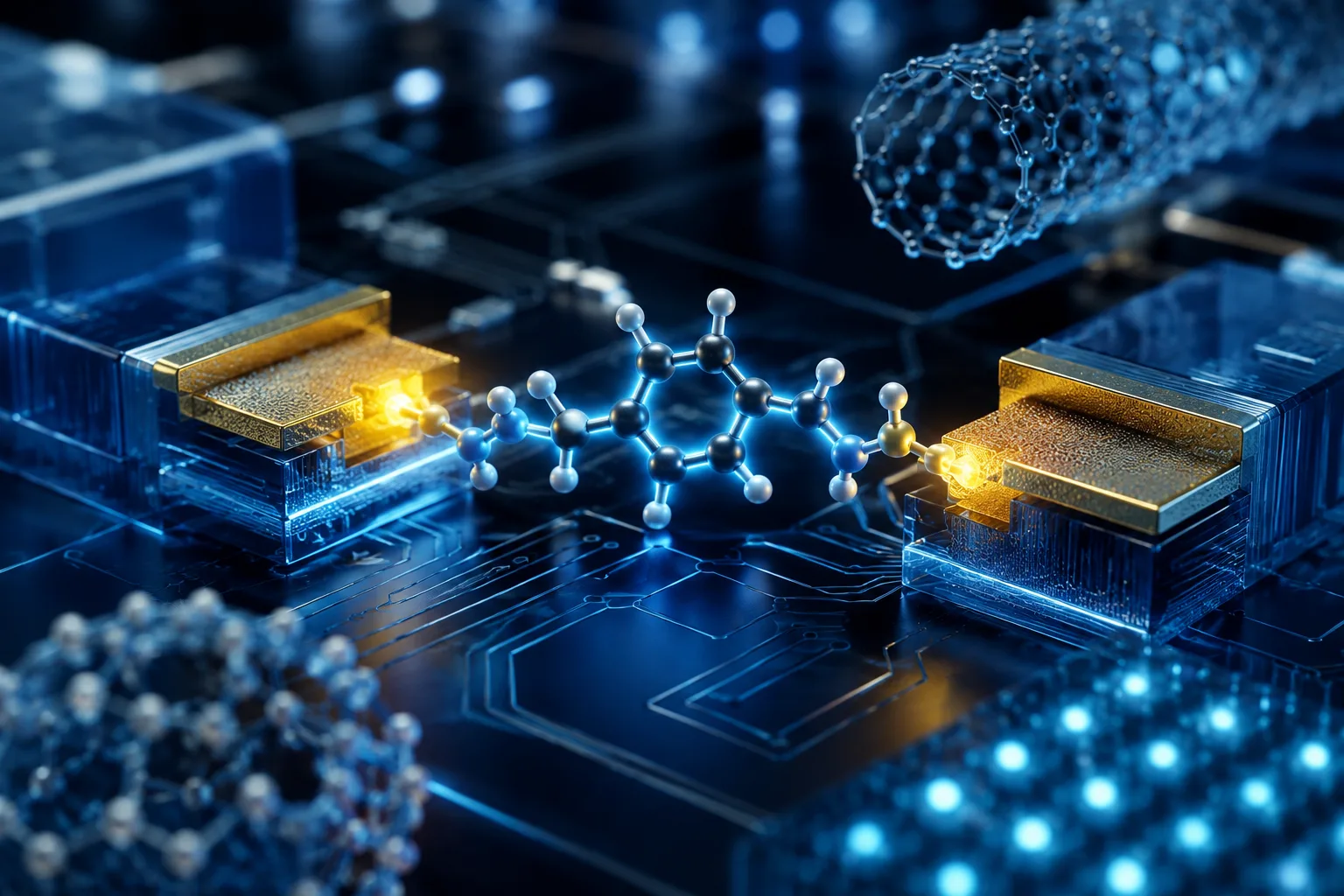
What is molecular electronics research? It is the scientific field focused on using single molecules or small molecular assemblies, instead of bulk silicon, as the working components of electronic circuits, including wires, switches, transistors, and memory elements.
Researchers study how electrons move through these molecules so engineers can eventually build devices far smaller and more energy-efficient than anything silicon can achieve. Silicon scaling is running out of room, and the industry’s next leap depends on understanding conduction at the molecular scale.
But that work requires instrumentation precise enough to see and manipulate matter at that resolution, and legacy tools drift out of calibration, parts disappear, and manufacturers stop answering the phone. This guide covers what molecular electronics research involves, the tools driving it, and where the field is headed.
Why Molecular Electronics Research is Becoming Essential Beyond Silicon
Traditional silicon transistors are approaching physical limits. Once features shrink below a few nanometers, quantum effects, heat dissipation, and fabrication costs make further miniaturization extremely difficult. Molecular electronics offers a way around this by using individual molecules, which are already one to a few nanometers in size, as functional circuit elements.
Market analysts have taken notice. The global molecular electronics market was valued at roughly 29 to 35 billion dollars in the 2025-2026 range, with projections showing it could grow several times over by the early 2030s as research and development activity accelerates.
Industry research also suggests that around 65 percent of current demand in this space still comes from academic and advanced R&D applications, not commercial production, which tells you how early-stage and research-driven this field remains.
What Are the Core Building Blocks of Molecular Electronics Technology?
Molecular electronics technology rests on a few foundational concepts that every researcher entering the field needs to understand.
- Molecular wires: Conjugated organic molecules capable of conducting electrons along their length, often used to connect nanoscale electrodes.
- Molecular switches: Molecules that can toggle between conductive and non-conductive states, forming the basis for molecular-scale logic and memory.
- Self-assembled monolayers (SAMs): Ordered molecular layers that form spontaneously on a surface, widely used to build reproducible molecular junctions.
- Single-molecule junctions: The point where a single molecule bridges two electrodes, the fundamental measurement unit in this field.
- Hybrid molecular-silicon architectures: Combining molecular components with conventional CMOS structures to improve reliability while retaining some scaling benefits.
Molecular wires hold the largest technology share today because of their conductance properties and the depth of research behind them, while molecular switches and hybrid molecular-silicon systems are the fastest-growing segments heading into the next decade.
How Do Researchers Actually Study Molecules at This Scale?
Studying conduction through a single molecule is not something you can do with standard lab equipment. Researchers rely on a specific set of techniques and instruments.
- Scanning probe microscopy (SPM), particularly Atomic force microscopy (AFM) and scanning tunneling microscopy (STM), is used to image and contact individual molecules or monolayers with sub-nanometer precision.
- Break junction techniques, where a nanoscale wire is stretched until it breaks, forming a gap of molecular dimensions that a single molecule can then bridge.
- Electrochemical AFM and conductive AFM, which measure current-voltage behavior of molecules under controlled electrochemical conditions, essential for electrochemistry and semiconductor research groups.
- Molecular self-assembly on substrates, followed by spectroscopy and microscopy to confirm structure before electrical testing.
- Computational modeling, using density functional theory and non-equilibrium Green’s function methods to predict conduction behavior before or alongside experimental work.
At Molecular Imaging, we understand that many laboratories continue relying on legacy AFM systems that require specialized expertise unavailable from general service providers. Supporting these researchers remains one of our core strengths while also delivering modern molecular electronics solutions for today’s multidisciplinary laboratories.
What Are the Real-World Applications of Molecular Electronics?
Molecular electronics is not purely theoretical anymore. Current and near-future applications include:
| Application Area | What Molecular Electronics Enables |
| High-density memory | Molecular switches store data at a fraction of the footprint of silicon flash cells |
| Biosensors | Molecular-scale sensitivity detects single biomolecules for diagnostics |
| Flexible and printable electronics | Molecular and organic components enable bendable circuits |
| Molecular logic devices | Basic computing operations performed at the single-molecule level |
| Semiconductor R&D | Hybrid molecular-silicon test structures inform next-generation chip design |
Healthcare and biomedical applications are currently the fastest-growing end-use segment for molecular electronics, driven largely by biosensing and diagnostic research, an area where many of our biotech and life sciences clients are already active.
What Challenges Are Slowing Down Molecular Electronics Research?
Despite the momentum, researchers consistently run into the same obstacles:
- Reproducibility: Single-molecule measurements are highly sensitive to contact geometry, so results can vary between labs and even between runs in the same lab.
- Instrument stability: Long-term drift in probe-based instruments can quietly corrupt data if systems are not properly maintained and calibrated.
- Manufacturing scale-up: Moving from a single verified molecular junction to millions of reliable devices remains an unsolved engineering problem.
- Aging equipment support: Many labs still rely on legacy AFM platforms that original manufacturers no longer service, leaving researchers without parts, calibration support, or trained technicians.
This last point is one we deal with constantly. Molecular electronics research depends on precise, well-calibrated AFM data, and a lab cannot afford unexplained drift or downtime when a system is mid-experiment. Our AFM parts and upgrades cover exactly this kind of support.
How Should Labs Choose Between Molecular Electronics Manufacturers, Suppliers, and Support Providers?
Whether you are evaluating new molecular electronics manufacturers for a modular AFM platform or trying to extend the life of an existing system, ask these questions before committing:
- Does the manufacturer or supplier still support the specific model you own, including firmware and probe compatibility?
- Can they provide calibration data and documentation that satisfy your institution’s or journal’s reproducibility standards?
- Is there a clear path for repairs, upgrades, and training, not just a one-time sale?
- Do they understand electrochemistry, biotech, and semiconductor use cases specifically, rather than offering generic instrumentation support?
We built our entire practice around the fourth point. Because we specialize in legacy Molecular Imaging and Agilent AFM systems, we’re often the only molecular electronics suppliers able to source parts, restore functionality, and retrain lab staff on systems that manufacturers have otherwise abandoned.
Bringing It All Together
Molecular electronics is one of the clearest paths beyond the limits of silicon, built on molecular wires, switches, and self-assembled structures, studied primarily through scanning probe techniques, and already finding early homes in memory, biosensing, and flexible electronics. The market data backs up what researchers are seeing on the bench: growth in this space is accelerating, and it is being driven overwhelmingly by academic and industrial R&D rather than mass production.
None of that research happens without dependable instrumentation. If your lab is running a legacy Molecular Imaging or Agilent AFM system and needs repairs, parts, calibration, upgrades, or hands-on training, or if you are evaluating a new modular AFM platform for molecular electronics research, Talk To Us at Molecular Imaging. We keep these systems running so your research doesn’t have to stop.
FAQs
What is the difference between molecular electronics and nanoelectronics?
Nanoelectronics is the broader category covering any electronic device built at the nanoscale, including nanoscale silicon transistors. Molecular electronics is a subset that specifically uses individual molecules as the active components.
Is molecular electronics commercially available yet?
Not widely. Most current activity is concentrated in academic and industrial R&D, with commercial products limited to niche memory, sensor, and flexible electronics applications.
What instrument is most important for molecular electronics research?
Atomic force microscopy is central to the field because it can image, position, and electrically characterize molecules with the sub-nanometer precision this research demands.
Why do research labs keep using older AFM systems instead of buying new ones?
Many legacy AFM platforms remain mechanically and optically excellent, and replacing an entire system is far more disruptive and costly than repairing, recalibrating, or upgrading the one already validated for a lab’s specific protocols.
What challenges exist in molecular electronics research?
Researchers commonly face challenges involving molecular stability, fabrication repeatability, surface characterization, and maintaining specialized research instrumentation.