
This approach solves a specific pain point. Contact mode's continuous lateral forces damage biological samples, tear apart soft polymers, and dislodge loosely-attached nanostructures. In the original 1993 study that introduced tapping, researchers found contact scanning caused irreversible damage to a viscoelastic polymer coating, while tapping produced clean, reproducible topography with contact forces as low as 0.1 nN (Zhong et al., Surface Science, 1993).
Below, we'll break down how tapping mode works mechanically, how it stacks up against contact and non-contact modes, where it shines application-wise, and what to look for when choosing an AFM system built for it.
Key Takeaways
- Tapping Mode oscillates the cantilever near resonance and touches the sample only briefly each cycle
- It is the dominant AFM technique because it balances resolution with sample protection
- Soft samples—biological materials, polymers, loosely bound nanostructures—stay intact where contact mode fails
- Phase imaging adds a second channel that maps material-property contrast beyond topography
What Is Tapping Mode Atomic Force Microscopy?
Tapping Mode AFM — also called intermittent-contact AFM or AM-AFM (amplitude-modulated AFM) — is one of three primary AFM operating modes, alongside contact mode and non-contact mode. The core principle: a cantilever oscillates at or near its resonance frequency, and the tip touches the surface only briefly at the bottom of each oscillation cycle.
In practice, that means:
- Oscillation near the cantilever resonance frequency
- Brief tip–sample contact only at the bottom of each cycle
- Much lower lateral (shear) force than continuous-contact scanning
- Feedback driven by amplitude (and phase), not static deflection
This differs from contact mode, where the tip stays on the surface and the feedback loop holds a constant deflection—and therefore a constant force—throughout the scan. Intermittent contact reduces the shear forces that cause tip-induced sample damage.
Tapping mode was developed specifically to solve that damage problem. The technique traces back to a 1993 paper by Zhong, Inniss, Kjoller, and Elings, which showed tapping-mode imaging of a fractured polymer/silica fiber surface where contact mode had failed.
With the cantilever oscillating, detection uses amplitude modulation: a lock-in amplifier tracks the drive signal and recovers oscillation amplitude and phase. The feedback loop then follows changes in tip–sample interaction as the tip approaches the surface.
How Tapping Mode AFM Works: The Technical Mechanics
The Feedback Loop
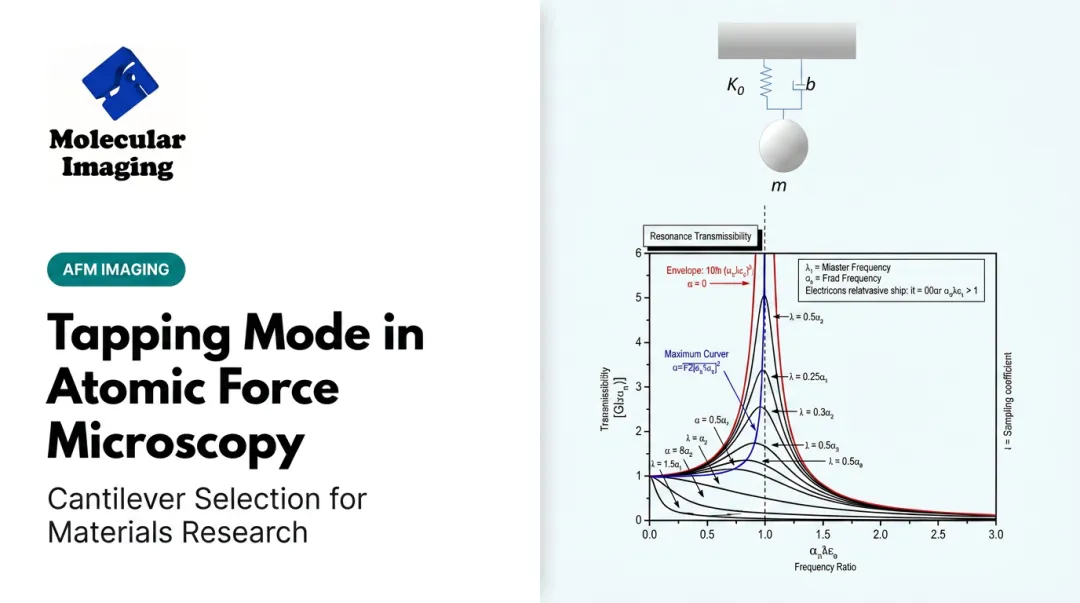
A piezo actuator drives the cantilever near resonance. As the tip approaches the surface, the interaction attenuates and stiffens the oscillation, changing the amplitude. A PID controller then moves the Z-piezo to restore that amplitude back to its setpoint. This amplitude — not force directly — is what tapping mode actually regulates.

University of Cambridge teaching resources note typical oscillation amplitudes of 20–100 nm. On the stiffness side, NIST research points to cantilevers around 40 N/m for tapping in air, dropping below 1.0 N/m for liquid environments — though these are source-specific figures, not universal specs.
What Tapping Mode Actually Measures
Tapping mode doesn't directly measure force at any instant. It reports an averaged mechanical response across many oscillation cycles. That's a tradeoff — you get gentler imaging, but the force applied to the sample can be somewhat ill-defined, especially in liquid.
Phase Imaging: A Secondary Channel
That same multi-cycle interaction also yields a second signal. Beyond topography, tapping mode records phase — the lag between the drive and the cantilever's actual oscillation. Phase shift correlates with:
- Adhesion differences between materials
- Local stiffness variation
- Viscoelastic and energy-dissipation properties
Phase imaging is useful for spotting material contrast invisible in a topography scan alone. That said, phase data is qualitative more often than quantitative — treat it as a supplementary map, not a chemical fingerprint.
Where It Gets Tricky
Feedback can become unstable when the tip crosses from a soft region of a sample to a hard one, since the amplitude response changes abruptly.
In fluid, damping reduces sensitivity to amplitude changes altogether. Free-amplitude drift can also shift the actual applied force without warning, a known limitation in liquid-phase tapping.
Tapping Mode vs. Contact Mode and Non-Contact Mode AFM
Each mode trades resolution against sample protection differently. Here's how they stack up:
| Mode | Tip-Sample Interaction | Typical Cantilever | Best For |
|---|---|---|---|
| Contact | Continuous contact; feedback holds constant deflection | 0.001-50 N/m (broad range) | Hard, durable materials needing max resolution |
| Tapping | Intermittent contact near resonance | ~40 N/m (air), <1.0 N/m (liquid) | Soft, biological, or loosely-bound samples |
| Non-contact | Tip hovers, senses long-range attractive forces | Stiff, ~100-400 kHz resonance | Ultra-delicate samples where any contact is unacceptable |

Contact mode wins on raw resolution for hard, robust materials, but the continuous lateral drag risks damaging or displacing anything soft. Non-contact mode is the gentlest option since the tip never touches the sample, but it sacrifices resolution and is much more sensitive to environmental noise.
Tapping mode lands between them: near-contact-mode resolution with a fraction of the lateral force.
Mode choice also determines which specialized techniques you can run:
- Tapping-based: Magnetic Force Microscopy (MFM) and Electrostatic Force Microscopy (EFM) use a topography pass, then a raised lift pass to sense long-range forces
- Contact-based: Scanning Capacitance Microscopy (SCM) and Conductive AFM (C-AFM/TUNA) rely on contact-mode electronics
If your research roadmap includes either family, that choice is a real hardware consideration.
Key Applications and Advantages of Tapping Mode AFM
Tapping mode's biggest advantage is simple: it lets you image things that contact mode would destroy.
Ideal sample types:
- Delicate biological structures (DNA, proteins, cell membranes)
- Soft polymers and thin films
- Loosely-bound nanostructures that shift under lateral force
- Battery electrode surfaces and coatings requiring non-destructive characterization
A Proven Track Record with Biological Samples
DNA imaging is one of tapping mode's clearest success stories. A 2021 review on AFM in DNA research notes that tapping's reduced lateral forces allowed researchers to image plasmid DNA in fluid with widths around 5 nm, versus tens of nanometers under contact mode.
Tapping also let researchers image DNA that was only loosely bound to a substrate, without knocking it out of position.
Protein imaging benefits similarly. A 2010 review in Molecular & Cellular Proteomics confirms that tapping's minimal-contact approach, combined with phase-channel material information, makes it a go-to for structural biology work — though phase data still requires careful interpretation.
Molecular Imaging's application documentation reflects this same pattern. Documented biological examples on Agilent/PicoPlus-style AFM platforms include:
- DNA nucleosomes imaged in water
- Chromatin in aqueous buffer
- Prion fibrils
- Vimentin protein on mica
On the materials side, PMMA morphology studies and block copolymer imaging show how tapping parameters directly shape the observed surface structure.
Practical operational bonuses:
- Extended tip life compared to continuous contact scanning
- Reduced sample contamination from tip-surface drag
- Compatibility with fluid-cell imaging for physiological conditions
Choosing the Right AFM System for Tapping Mode Imaging
Not every AFM platform handles tapping mode equally well. A few things matter more than spec-sheet marketing.
What to Look For
- Modular probe/nose-cone design: Switching between tapping, contact, and specialized modes (MFM, EFM, KPFM) without swapping the entire microscope saves time and money.
- Stable amplitude/phase electronics: Reliable near-resonance drive and lock-in detection keep feedback stable across varied samples.
- Environmental control options: Temperature stages and isolation chambers extend tapping mode's usefulness into thermal studies, battery research, and reactive-gas work.
- Probe selection matched to sample and medium: Air imaging and liquid imaging call for different cantilever stiffness classes.
How Molecular Imaging's Platforms Fit
Molecular Imaging's 5500 PicoPlus AFM+STM system uses interchangeable nose cones that support AFM, STM, tapping mode, KPFM, EFM, and MFM on one modular platform. Scan ranges cover 90 μm × 90 μm for standard work or 9 μm × 9 μm for atomic-resolution imaging. That modularity matters if your lab's research shifts between materials science and life sciences projects over time.

For environmental control, Molecular Imaging offers:
- Temperature-controlled stages spanning −30°C to 250°C, suited for phase-transition and crystallization studies
- An Environmental Isolation Chamber for humidity, temperature, and low-oxygen or gas atmospheres, relevant for battery and reactive-gas research
On the probe side, Molecular Imaging carries tapping-mode cantilevers across frequency classes. Options range from the high-frequency NCH-30-10 for rapid air imaging to the liquid-compatible Si-L-10 and Si3N4-L-10 for biological and polymer samples in aqueous environments.
For labs running older tapping-capable systems, ZoomAFM provides diagnostics, calibration, preventive maintenance, and remote or on-site repair support. That makes it a practical option for facilities keeping legacy Agilent 5500/4500 platforms running rather than replacing them outright.
Frequently Asked Questions
What are the differences between tapping mode and contact mode AFM?
Contact mode keeps the tip in continuous contact with the surface, applying constant force via feedback on deflection. Tapping mode oscillates the tip so it only briefly touches the sample each cycle. That cuts lateral forces and makes it better suited to soft or delicate samples.
What are the different modes of an AFM?
The three primary modes are contact, non-contact, and tapping (intermittent contact). Specialized modes built on these include MFM, EFM/KFM, SCM, and conductive AFM (C-AFM/TUNA) for magnetic, electrical, or conductive contrast.
What is atomic force microscopy and how does it work?
AFM uses a sharp tip on a flexible cantilever to scan a sample's surface. A laser reflects off the cantilever onto a photodetector. A feedback loop holds a chosen tip-sample interaction and records the Z-motion that builds the topography map.
Can tapping mode AFM damage samples?
Tapping mode reduces lateral shear compared with contact mode, but it does not remove damage risk entirely. Tip wear, fluid damping, and force variation in liquid can still affect sensitive samples.
What is phase imaging in tapping mode AFM?
Phase imaging measures the lag between the cantilever's drive signal and its actual oscillation. This phase shift often correlates with adhesion, stiffness, or viscoelastic differences, revealing material contrast that topography alone can't show.
Is tapping mode AFM suitable for biological samples?
Yes. Lower lateral force suits soft biological samples such as DNA, proteins, and cell membranes, in air or in liquid that mimics physiological conditions.