
Water vapor, temperature swings, and reactive gases interact with the tip and sample in ways that distort topography, adhesion, and mechanical data. Researchers studying battery electrodes, proteins, or thin polymer films can't afford that noise.
Environmental control chambers solve this by isolating the sample and cantilever from ambient fluctuations. This guide covers what these chambers are, how they eliminate common imaging artifacts, and how to choose the right one for your lab.
Key Takeaways
- Environmental chambers regulate temperature, humidity, and gas composition to protect AFM measurement accuracy
- Uncontrolled humidity creates capillary forces that cause adhesion and topography artifacts
- Modular systems, including stages spanning -30°C to 250°C, support research from battery studies to bioimaging
- Inert atmospheres enable imaging of reactive materials, like battery electrodes, without oxidation interference
What Is an Environmental Control Chamber for AFM?
An environmental control chamber for AFM is an enclosure or add-on system that regulates temperature, humidity, and/or atmosphere around the sample and cantilever during scanning. It isolates the tip-sample junction from outside air while keeping the microscope fully functional.
This differs sharply from general industrial environmental test chambers. Those are built for product durability testing—think stress-testing a phone casing at extreme temperatures. AFM chambers exist for measurement precision, not endurance testing.
A 2007 study in Review of Scientific Instruments describes enclosing a commercial AFM in a compact aluminum chamber. The setup could reach high vacuum or a controlled gas atmosphere while preserving performance nearly identical to the unmodified instrument.
Core Components
Most AFM environmental chambers include:
- A sealed enclosure surrounding the sample and cantilever holder
- Humidity or gas inlet-outlet ports for atmosphere exchange
- A temperature-controlled sample stage
- Real-time sensors for humidity, temperature, or oxygen levels
How It Fits the AFM Itself
AFM systems rely on a few core parts. A nanometer-scale tip sits on a flexible cantilever. Tip-sample forces bend that cantilever, and a laser reflecting off it hits a photodetector to generate the feedback signal. A piezoelectric scanner handles precise positioning.
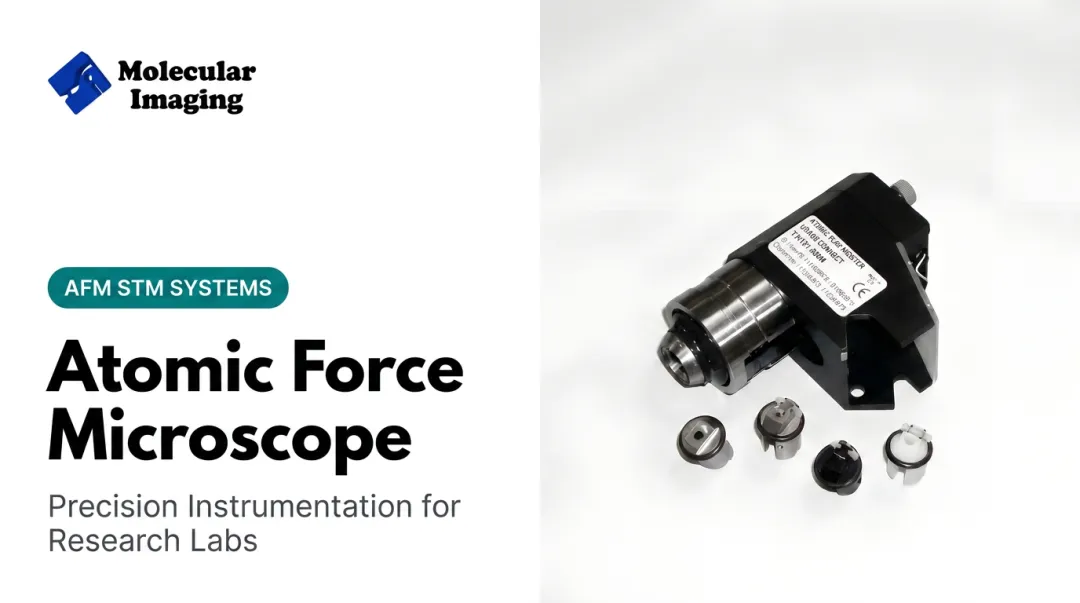
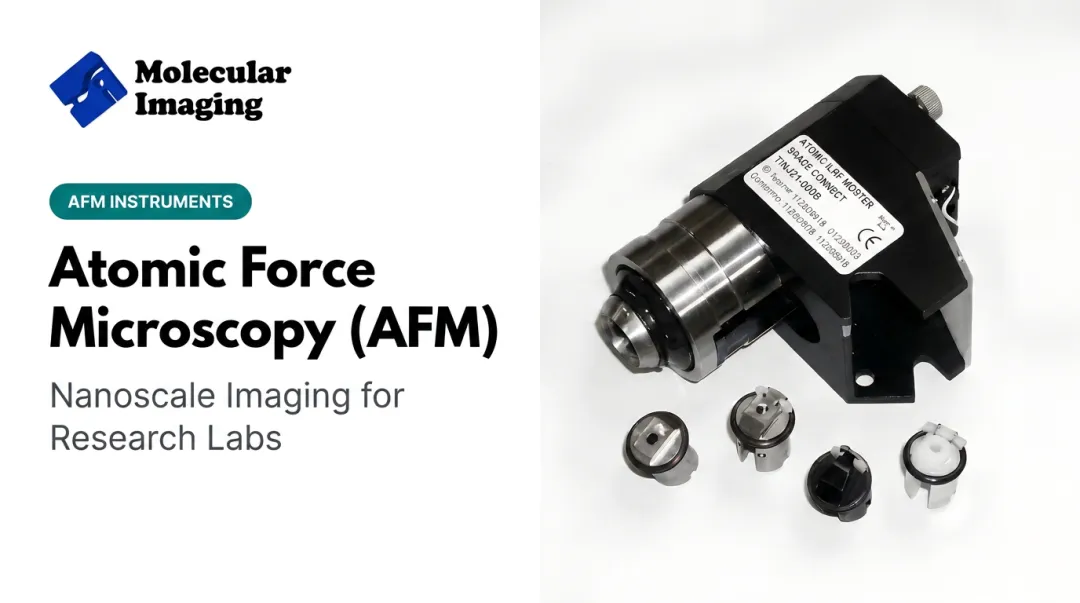
The environmental chamber wraps around this assembly without disrupting laser alignment or scanner motion. Molecular Imaging's systems, for instance, use a top-down Pendulum Multipurpose Scanner with open-top optical access. That design lets the enclosure surround the tip-sample junction while keeping the laser path clear.

How Environmental Control Solves Key AFM Imaging Challenges
Humidity and Capillary Forces
When humidity climbs, a thin water layer forms on most surfaces. Bring an AFM tip close enough, and a capillary bridge forms between tip and sample. This distorts adhesion measurements and can throw off topography data entirely. Research backs this up with real numbers. A study testing silicon-nitride probes against hydrophilic stainless steel found adhesion forces peaked between 25-35% relative humidity, eased through the 35-55% range, then rose again near 65% RH. The pattern depended heavily on how hydrophobic the substrate was; on PMMA, the effect nearly disappeared. A dedicated humidity-control chamber can hold conditions steady within ±0.2% relative humidity across a 5-95% range, according to peer-reviewed instrumentation published in Review of Scientific Instruments. That kind of stability makes capillary artifacts far more predictable, or removes them from the equation entirely.

Temperature Drift Ruins Long Scans
Thermal expansion in the cantilever and scanner components creates a slow, creeping error during extended imaging sessions. The tip-surface distance shifts over time even when nothing else changes. For scans lasting hours, that drift can warp an entire dataset. A temperature-controlled stage or chamber holds the sample and scanner at a fixed setpoint so expansion no longer walks the tip off the surface mid-scan.
Gas Control for Reactive Materials
Some samples simply can't tolerate exposure to normal air. Battery electrodes oxidize. Certain electrochemical surfaces react with ambient moisture within seconds. Researchers studying lithium-oxygen battery chemistry built a sealed AFM cell inside a glovebox held below 0.1 ppm water and oxygen, then held oxygen at 100-200 mbar during operation. With that atmosphere locked in, AFM tracked discharge products nucleating and growing on a cathode, then disappearing during recharge—an interaction impossible to observe in open air.
Reproducibility for Peer Review
Stable conditions do more than suppress artifacts. When RH, temperature, and gas composition stay at known setpoints, force curves and topography traces line up across runs, labs, and instruments—what peer review and regulatory submissions actually require.
Biological Samples Need Hydration, Not Just Stability
Proteins and cells lose their native structure fast when they dry out. BioAFM imaging depends on maintaining hydration throughout a scan. Early work in PNAS demonstrated that AFM could produce faithful high-resolution images of protein surfaces in an aqueous environment, a finding that helped launch modern bioAFM as a field.
Key Features and Types of Environmental Control Systems
Not every chamber does the same job. Here's how the main types break down:
- Temperature-controlled stages handle thermal studies across a wide range. Molecular Imaging's stages, for example, cover -30°C to 250°C, useful for polymer phase transitions, thermal analysis, and material behavior under heat stress.
- Sealed isolation chambers manage humidity and gas composition, often with purging for inert atmospheres. These are the go-to solutions for battery research, reactive-gas studies, and samples sensitive to oxygen or moisture.
- Closed-loop feedback systems use real-time sensors to hold conditions steady rather than setting a target and leaving it unmonitored. That stability matters most during multi-hour scans where drift would otherwise creep in.
- Miniaturized, localized chambers fit over the tip-sample junction instead of enclosing the whole instrument. Smaller volume means faster response and less purge gas, a practical edge for frequent experiments.

Which type you need depends on the experiment—and on whether your AFM platform can take modular environmental accessories without a full system swap.
Molecular Imaging's Environmental Solutions
Molecular Imaging builds environmental control accessories specifically for its 5500, 5100, and 5420 series platforms. The Environmental Isolation Chamber supports humidity, temperature, low-oxygen, and gas control for the 5500 PicoPlus AFM+STM system, addressing applications like polymer analysis and reactive-gas work.
The company also offers a humidity-control device for semi-closed environments, along with temperature-controlled stages spanning that -30°C to 250°C range. These accessories integrate with the modular sample-stage design rather than requiring a full instrument replacement, an important distinction for labs upgrading existing systems.
Applications Across Research Fields
Environmental control chambers support AFM research across materials science, life sciences, and electrochemistry:
- Battery materials: In-situ AFM of LiFePO4 thin-film electrodes has tracked grain-size changes of 19.3% during charge and 27.8% during discharge, documented in a custom liquid cell under electrochemical control.
- Polymers: High-temperature stages (up to 250°C) enable in-situ studies of phase transitions.
- Life sciences: BioAFM imaging of cells and proteins needs stable hydration to preserve native structure, especially for high-speed live-cell work.
- Electrochemistry and molecular electronics: Controlled-atmosphere AFM lets researchers watch surface reactions unfold, such as morphological changes on a gold electrode during oxygen-reduction under potential control.

Choosing the Right Environmental Control Chamber for Your AFM
Before purchasing, work through these considerations in order:
- Define your requirements first. Do you need precise temperature, humidity, or full atmosphere/gas control? Battery researchers need inert gas purging. BioAFM users need stable hydration. Polymer scientists often need high-temperature stages.
- Check platform compatibility. Confirm the chamber integrates with your existing AFM or STM system. Modularity matters here: you want the option to add capabilities later without buying a new instrument.
- Evaluate response time and monitoring. How fast does the chamber stabilize after a condition change? Can you log data over time for reproducibility documentation?
- Consider ease of integration. A chamber that requires extensive rewiring or software changes adds friction to every experiment.
Working with a manufacturer that builds both the AFM platform and the environmental accessories simplifies this process. Molecular Imaging's team combines application-specific engineering with direct technical support. That pairing helps when you retrofit a chamber onto a legacy 5500 series system instead of guessing at compatibility alone.
Frequently Asked Questions
What is an environmental control chamber?
It's an enclosure that regulates temperature, humidity, or atmosphere around a sample during scientific measurement or testing. For AFM, this means protecting the tip-sample interaction from ambient interference.
What are the main components of an AFM?
The core components are the cantilever, a sharp tip mounted at its free end, a laser and photodetector system, and a piezoelectric scanner. Tip-sample forces bend the cantilever, and the laser reflection measures that deflection.
Is AFM the same as SEM?
No. AFM measures surface forces with a physical probe and can run in ambient air or liquid. SEM uses an electron beam and typically needs vacuum, so sample prep and operating conditions differ.
How does humidity affect AFM measurements?
Uncontrolled humidity creates a thin water layer on surfaces, forming capillary bridges between tip and sample. This distorts adhesion measurements and can introduce topography artifacts, particularly on hydrophilic materials.
Can environmental chambers be added to an existing AFM system?
Yes. Many modular systems, including Molecular Imaging's Environmental Isolation Chamber, integrate with existing AFM/STM platforms like the 5500, 5100, and 5420 series without requiring a full instrument replacement.