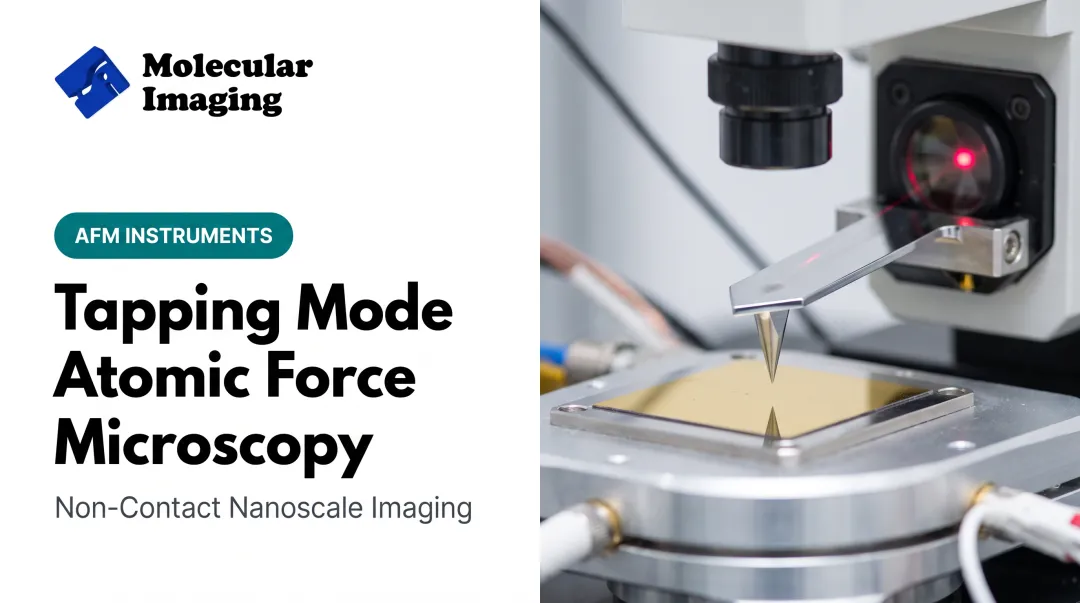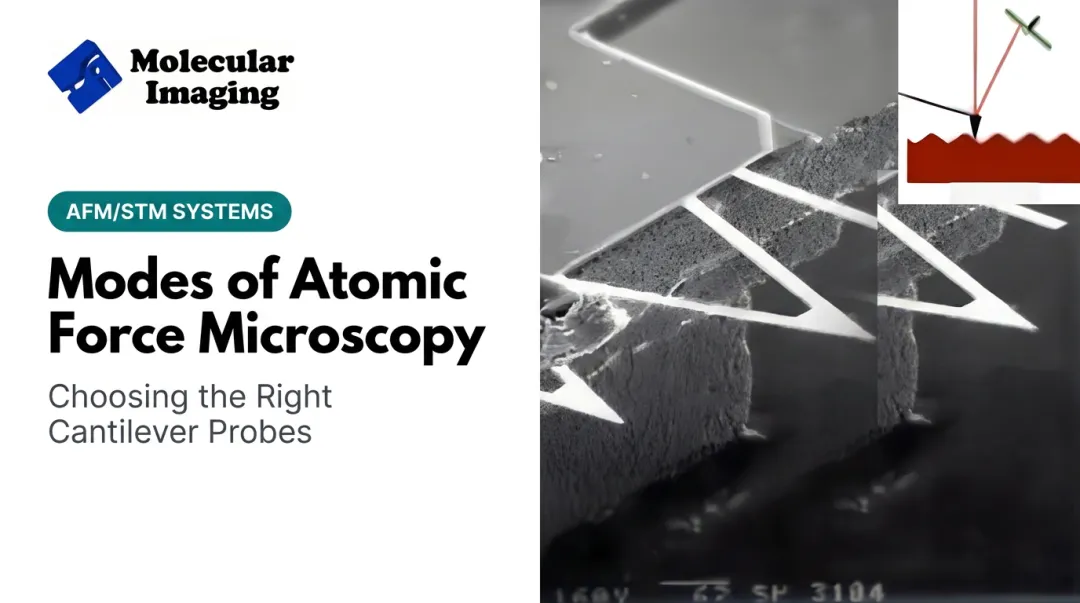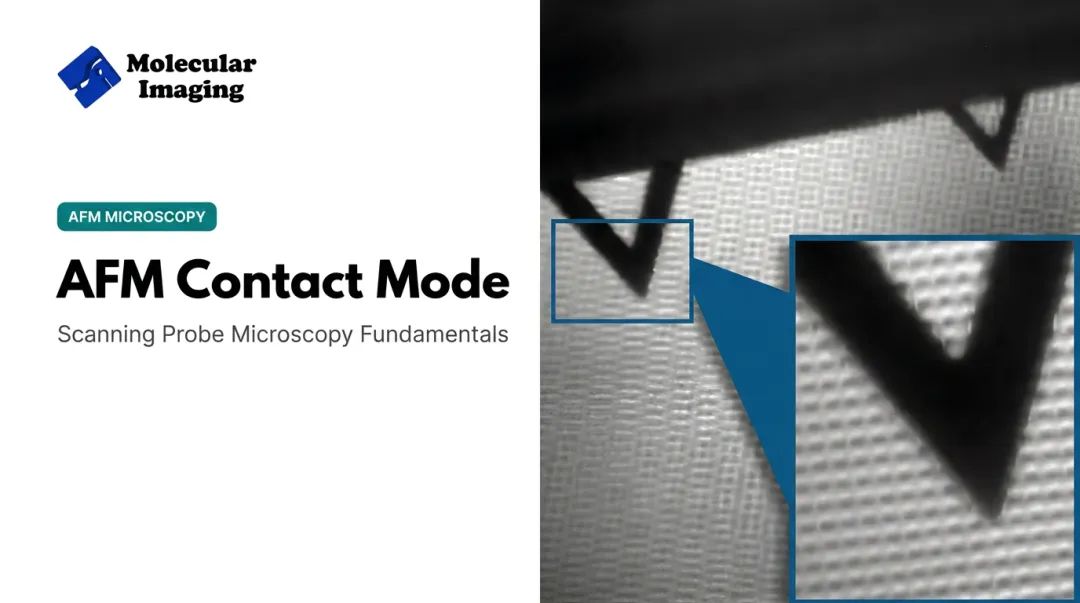

Non-contact mode (nc-AFM) sidesteps this entirely. The cantilever oscillates a few nanometers above the surface, sensing attractive forces instead of pushing into the sample. No contact means no wear, no distortion, and — in the right conditions — atomic-level detail.
This article breaks down the physics behind non-contact mode, how it compares to contact and tapping mode, where it delivers the most value, and what hardware makes it work reliably in a real lab.
Key Takeaways
- Detects attractive van der Waals forces without ever touching the sample
- Preserves tip sharpness and sample integrity better than contact or tapping mode
- FM suits ultra-high vacuum; AM is simpler and more common for ambient imaging
- Requires stiff cantilevers and stable, low-drift hardware for reliable results
What Is Non-Contact Mode in AFM?
Non-contact mode is a dynamic AFM technique. The cantilever oscillates at or near its resonance frequency while hovering tens to hundreds of angstroms above the sample — close enough to sense attractive forces, far enough to avoid contact entirely.
Compare that to tapping mode, where the tip briefly touches the surface at the bottom of each oscillation cycle. In contact mode, the tip stays in continuous physical contact.
The Lennard-Jones Model
The standard way to describe tip-sample interaction is the Lennard-Jones potential. It captures two competing forces:
- Long-range attraction (van der Waals forces): dominant at larger separations
- Short-range repulsion (Pauli exclusion): takes over once atoms get close enough to "touch"
Non-contact mode operates entirely in that first, attractive region. Contact and tapping modes dip into the repulsive zone, which is why they risk damaging fragile samples.

A Landmark Result
Non-contact mode was the first AFM technique to reach true atomic resolution. In 2009, researchers at IBM Zurich used nc-AFM with an atomically defined tip to resolve the internal chemical structure of a single pentacene molecule. That result, published in Science, reshaped what researchers believed AFM could see.
A 2012 follow-up from the same group went further, distinguishing individual carbon-carbon bond orders within polycyclic aromatic molecules.
Naming Conventions Worth Knowing
Researchers encounter several overlapping terms. They're related, but not interchangeable:
| Term | What it actually means |
|---|---|
| True Non-Contact Mode | Vendor term (Park Systems) for attractive-regime imaging without contact |
| Dynamic Force Microscopy | Umbrella term for any oscillating-cantilever AFM technique |
| FM-AFM | Dynamic mode that tracks resonance frequency shift directly |
| AM-AFM | Dynamic mode that tracks amplitude change; often associated with tapping |
How Non-Contact Mode Works
A piezoelectric element drives the cantilever near its resonance frequency. As the tip approaches the surface, van der Waals attraction effectively softens the cantilever's spring constant, producing a measurable shift in resonance frequency. The whole imaging process hinges on detecting that shift accurately and responding quickly.
Frequency vs. Amplitude Modulation
There are two ways to read that signal:
- Frequency Modulation (FM): A phase-locked loop tracks the resonance shift directly. That precision suits atomic-resolution work, but it requires simultaneous control of demodulation, frequency, and amplitude loops—so FM is more common in UHV labs than ambient setups.
- Amplitude Modulation (AM): Drive frequency stays fixed near free resonance; the system monitors amplitude changes. A single feedback loop makes AM simpler and dominant for ambient-air imaging.
The Z-Feedback Loop and Topography Reconstruction
The feedback system constantly adjusts the Z-scanner to hold either amplitude or frequency shift at a fixed setpoint. That vertical movement, tracked point by point, becomes the topography map.
Speed matters here more than in most imaging modes. The attractive force window is narrow (a few angstroms wide in practice), and a sluggish feedback loop risks the classic snap-to-contact failure, where the tip suddenly jumps from hovering to touching the surface.
Cantilever Requirements
Preventing snap-to-contact starts with the probe itself. Stiffer cantilevers with higher resonance frequencies resist that instability:
- Standard silicon cantilevers, such as Bruker's TESP-SS, run around 42 N/m and 320 kHz
- Specialized qPlus quartz sensors, like Scienta Omicron's NC-AFM sensor, reach roughly 1,800 N/m at 33 kHz (unmounted)
Because these stiffer probes oscillate with much smaller amplitudes, they can maintain stable attractive-force sensing where a softer cantilever would simply crash into the surface.

Non-Contact Mode vs. Contact Mode vs. Tapping Mode
Each mode trades speed for gentleness in a different way.
| Factor | Contact Mode | Tapping Mode | Non-Contact Mode |
|---|---|---|---|
| Force regime | Repulsive, continuous contact | Repulsive, intermittent contact | Attractive, no contact |
| Scan speed | Fastest | Fast | Slowest |
| Tip/sample damage risk | Highest (lateral shear forces) | Low | Lowest |
| Resolution potential | Good for hard, rigid samples | High-resolution topography | Atomic/molecular-scale possible |
| Best environment | Ambient, liquid | Ambient, liquid | UHV (most reliable), also liquid |
Contact mode handles extreme topography and scans fast, but constant contact generates lateral shear forces that wear down tips and can drag soft samples right off the surface.
Tapping mode became the industry default because it eliminates most of that lateral force while still working in ambient air and liquid. The tip still touches the sample briefly at the bottom of each cycle, making it a useful compromise rather than a full non-contact solution.
Non-contact mode is the only technique that avoids physical contact entirely, which makes it the best option for the most delicate samples and the highest-resolution work. The cost is slower scanning and a more demanding setup.
Why Ambient Air Complicates Things
Here's the catch: most surfaces in ambient conditions carry a thin adsorbed water layer. As the tip approaches, that film can suddenly form a capillary bridge and pull the tip into contact before it ever reaches the intended attractive-force setpoint.
This jump-to-contact effect caused by water-mediated capillary forces is well documented. True non-contact operation therefore performs most reliably in ultra-high vacuum or tightly controlled environments, rather than open air.
Advantages, Limitations & Applications of Non-Contact AFM
Key Advantages
- Preserves tip sharpness across extended scan series
- Non-invasive enough for soft or biological samples
- Capable of atomic and even subatomic resolution
- Stable for long-duration measurements without frequent recalibration
Key Limitations
- Slower scan speeds than contact or tapping mode
- Feedback tuning is more complex, especially with FM detection
- Ambient fluid layers can disrupt the narrow attractive-force window
- Requires specialized stiff cantilevers or quartz sensors
Where Non-Contact Mode Excels
Non-contact mode is especially strong for:
- Atomic-resolution surface science: the original domain where the method proved itself
- Semiconductor and thin-film characterization: surface integrity matters as much as resolution
- Soft polymer research: any contact force risks deforming the sample
- Molecular electronics: simultaneous STM/AFM measurement reveals both structure and electrical behavior
A 2021 study used cantilever-based nc-AFM at 5 K, under vacuum below 10⁻¹¹ Torr, to identify ordered xenon islands on graphene grown on Pt(111) through force spectroscopy. The measurement distinguished adsorbed atoms from the underlying substrate without needing full atomic resolution.
That result shows how non-contact force sensing extends beyond imaging into chemical identification.
For labs working on charge transport or nanoscale electronic properties, Molecular Imaging's 5500 PicoPlus AFM+STM is built for this dual-technique workflow. Its modular nose cone architecture lets researchers switch between AFM and STM on the same platform without swapping instruments.

Choosing the Right AFM System for Non-Contact Imaging
Reliable non-contact imaging depends on hardware that can hold a narrow attractive-force window steady for hours at a time. Look for:
- Decoupled Z and XY scanners: independent axis control reduces cross-talk and keeps the feedback loop responsive
- Low-noise detection electronics: needed to resolve the small resonance shifts non-contact mode relies on
- Fast feedback response: critical for avoiding snap-to-contact in that narrow attractive zone
Environmental stability matters just as much as the scanner itself. Thermal drift, vibration, and ambient humidity all interfere with the fine control non-contact mode demands.
Molecular Imaging's temperature-controlled sample stages (rated -30°C to 250°C) and environmental isolation chambers manage humidity, temperature, oxygen, and gas atmosphere so those variables stay in check during sensitive dynamic-mode work.
Already running an AFM/STM system that's drifting out of spec or showing inconsistent cantilever performance in non-contact operation? Molecular Imaging's ZoomAFM service handles diagnostics, calibration, and repair so labs can restore the precision that non-contact imaging requires.
Frequently Asked Questions
What is the main difference between non-contact mode and tapping mode?
Non-contact mode never touches the sample, detecting only long-range attractive forces. Tapping mode makes brief, intermittent contact at the bottom of each oscillation cycle.
Why does non-contact AFM work best in ultra-high vacuum?
In ambient air, an adsorbed water layer on the sample can interfere with detecting the narrow attractive-force window. UHV or tightly controlled environments avoid this problem entirely.
Can non-contact mode be used to image biological samples?
Its non-invasive nature makes it well-suited to soft, fragile samples like biomolecules and polymers. That said, tapping or liquid-based modes are more commonly used for biological imaging in ambient or liquid conditions.
What type of cantilever is required for non-contact AFM?
Stiffer cantilevers with higher resonance frequencies, or specialized sensors like qPlus quartz sensors, help prevent the tip from snapping into contact with the sample.
Is non-contact mode slower than contact or tapping mode?
Generally, yes. Maintaining stable feedback within a narrow attractive-force window takes more careful control, which slows down scanning compared to contact or tapping mode.
What is frequency modulation (FM) AFM and how does it relate to non-contact mode?
FM-AFM is a non-contact detection method that tracks resonance frequency shifts directly through a phase-locked loop. It's the standard approach for atomic-resolution imaging in ultra-high vacuum.