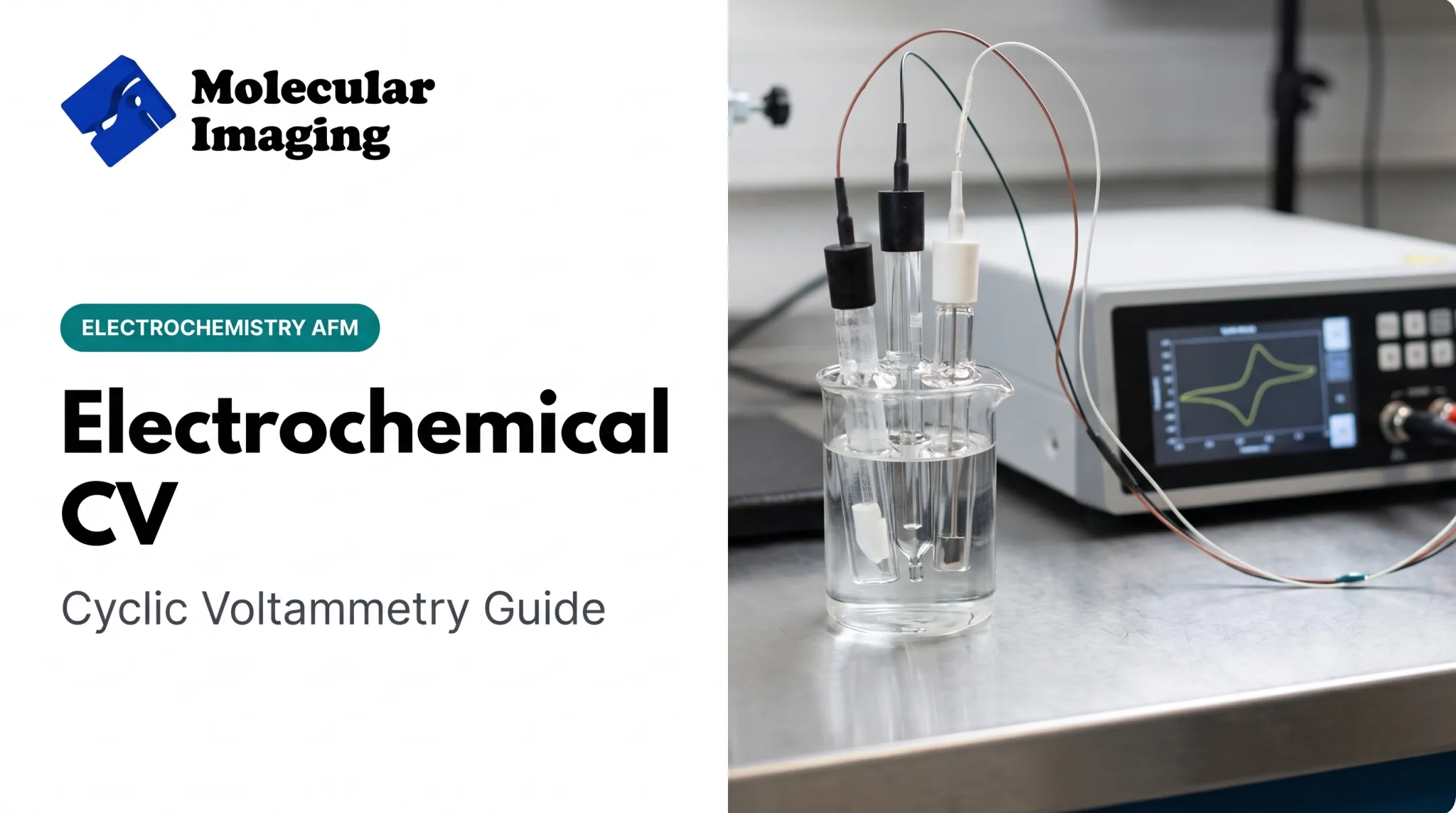

Many researchers struggle to keep these terms straight, and a third instrument, the potentiometer, often gets lumped in by mistake. That confusion isn't trivial: choosing the wrong control mode or misunderstanding instrument specs can quietly ruin months of data.
This guide breaks down what each instrument does, how the three-electrode system works, and where these tools show up in real research — from battery cycling to corrosion testing. We'll also cover how pairing a potentiostat/galvanostat with in-situ AFM/STM imaging lets you watch nanoscale surface changes as they happen, not just infer them afterward.
Key Takeaways
- Potentiostats control voltage and measure current; galvanostats reverse that role, and most instruments now do both.
- Three-electrode cells (working, reference, counter) deliver accurate, drift-free measurements.
- Researchers use them to study batteries, corrosion, fuel cells, and biosensors.
- Pairing electrochemical control with AFM/STM shows real-time surface changes during redox reactions.
What Is a Potentiostat and Galvanostat in Electrochemistry?
A potentiostat controls the potential (voltage) between a working electrode and a reference electrode, then measures the current that results. The name is literal: it keeps ("stat") the potential steady.
A galvanostat does the opposite. It applies a fixed current between the working and counter electrodes and measures the resulting voltage. Historically, this mode was central to constant-current battery charge and discharge testing.
In short, the two modes invert what is controlled and what is measured:
- Potentiostat: holds voltage steady and records the resulting current
- Galvanostat: holds current steady and records the resulting voltage
In practice, most modern lab instruments are combined units—often called a "potentiostat/galvanostat" or an "electrochemical workstation." You switch modes in software rather than swapping hardware.
Why not just use a power supply? Because a plain voltage source can't isolate a specific reaction at the electrode surface. Potential/current control lets you target exactly the redox process you want to study, without other reactions muddying the signal.
A Quick Word on History
The three-electrode principle traces back to Archie Hickling, who in 1942 at the University of Leicester built an automatic feedback circuit that held a working electrode's potential steady relative to a reference. Hickling's 1942 paper describes a device that compared measured potential against a setpoint and adjusted current until they matched—the same feedback logic every modern potentiostat still uses.
How Potentiostats and Galvanostats Work: The Three-Electrode System
Nearly every serious electrochemical measurement uses three electrodes, each with a distinct job:
- Working electrode (WE): where the reaction of interest happens
- Reference electrode (RE): provides a stable potential benchmark, ideally carrying no current
- Counter electrode (CE): completes the circuit and carries the bulk current

Separating the reference from the counter electrode matters. If one electrode had to both sense potential and carry current, polarization at that electrode would corrupt your measurement.
The Feedback Loop
A control amplifier constantly compares the measured WE-RE potential to your setpoint. Any mismatch triggers an adjustment in current through the counter electrode. The loop runs continuously, often thousands of times per second.
Switching Modes
- Potentiostatic mode: fixed voltage, current is the output
- Galvanostatic mode: fixed current, voltage is the output
Those two modes cover most DC experiments. Whether they succeed in a real cell still depends on two instrument limits.
Specs That Actually Matter
- Compliance voltage: maximum voltage the instrument can drive through the counter electrode to hold your setpoint. Cell resistance and poor electrolyte conductivity consume that budget quickly—a nominal 10 V need often requires far more headroom once uncompensated resistance is included.
- Current range: match the expected signal to the instrument range or you lose resolution. A pA-level biosensor and an amp-scale battery test need very different settings.
Most workstations also support techniques beyond basic DC control:
- Open Circuit Voltage (OCV): lets the cell equilibrate with no applied control
- Electrochemical Impedance Spectroscopy (EIS): applies an AC signal to map impedance across a frequency range

Potentiostat vs Galvanostat vs Potentiometer: Key Differences
Here's where the terminology confusion usually starts.
| Instrument | Controls | Measures | Typical Use |
|---|---|---|---|
| Potentiostat | Potential | Current | CV, corrosion, biosensors |
| Galvanostat | Current | Potential | Battery cycling, deposition |
| Potentiometer | Neither (passive) | Voltage division via wiper | Old-style reference circuits, not electrochemical control |
A potentiometer is a different instrument entirely: a variable resistor with a moving wiper, used to passively measure or divide voltage. It doesn't actively control an electrochemical cell at all. Confusing it with a potentiostat is a common but easily fixed mistake.
In practice, you almost never have to choose between a standalone potentiostat and a standalone galvanostat anymore. Combined instruments switch modes within a single protocol, so the "choice" happens in software, not at purchase time.
Applications of Potentiostats and Galvanostats in Research
Potentiostats and galvanostats underpin research wherever reaction kinetics, material stability, or interfacial behavior must be measured under controlled potential or current.
Battery Research
- Charge/discharge cycling under galvanostatic control to test capacity and aging
- GITT and PITT techniques (current-step and potential-step methods) to extract diffusion coefficients for electrode materials
- Capacity fade analysis over hundreds of cycles to quantify long-term aging
Corrosion Science
- Tafel analysis plots log-current against potential; extrapolating the linear regions gives corrosion current
- Linear Polarization Resistance (LPR) measures the slope near the free-corrosion potential (typically under 20 mV) to calculate corrosion rate directly
- Electrochemical impedance spectroscopy (EIS) probes coating integrity and interfacial resistance without strongly polarizing the sample
Electrocatalysis, Fuel Cells, and Biosensors
- Cyclic voltammetry scans potential and records current to identify redox behavior
- Chronoamperometry tracks current over time, useful for quantifying diffusion-limited reactions
- Electrochemical impedance spectroscopy (EIS) characterizes charge-transfer resistance and interfacial capacitance in catalyst and sensor development

Demand for this kind of testing is climbing fast. The EV battery-testing market is projected to reach $9.51 billion by 2030, growing at a 19.0% CAGR, according to a December 2024 MarketsandMarkets report. That growth is drawing more labs into routine electrochemical characterization.
Using Potentiostats/Galvanostats with In-Situ Electrochemical AFM/STM Imaging
Running a potentiostat tells you what current or voltage a reaction produced. It doesn't show you what happened on the electrode surface. That's where in-situ AFM and STM imaging come in.
Watching Reactions Happen
EC-AFM and EC-STM setups use the same three-electrode principle as a standard electrochemical cell, but the AFM cantilever or STM tip sits alongside the working electrode inside the liquid cell. As the potentiostat drives a reaction, the tip images the surface in real time, capturing:
- Electrodeposition as it builds up, atom by atom
- Corrosion pitting as it initiates and spreads
- Catalyst morphology changes under applied potential
Published studies have used exactly this approach to image copper deposition on gold at atomic resolution, monitor cathodic corrosion on platinum, and track etching behavior on passivated gold surfaces (Langmuir, 1997). None of these results were visible from electrical data alone.

Where Molecular Imaging Fits
Molecular Imaging's 5500 PicoPlus AFM+STM platform supports in-situ electrochemistry with interchangeable AFM/STM nose cones, 9 μm × 9 μm or 90 μm × 90 μm scan ranges, and liquid-cell configurations rated for acidic, basic, and organic-solvent environments. Supporting documentation, including an EC Manual and dedicated electrochemistry tools, backs applications in:
- Battery interface and SEI (solid-electrolyte interface) studies
- Real-time corrosion monitoring
- Molecular electronics research using conductive AFM (CSAFM) alongside STM
For labs already running a potentiostat, the modular nose-cone design and electrochemistry interface mean you are not starting from zero. Configurable liquid cells and standard electrode arrangements let many existing cell setups be adapted rather than replaced.

Exact compatibility depends on your electrode geometry and should be confirmed with Molecular Imaging's technical team.
Frequently Asked Questions
What is a potentiostat in electrochemistry and how does it work?
A potentiostat controls the potential between a working and reference electrode while measuring the resulting current. It uses a feedback loop and the standard three-electrode setup to isolate a specific reaction for study.
How much does a potentiostat cost?
Prices vary widely: portable units start around $1,000 before tax and shipping, while multichannel research-grade systems with EIS run into the tens of thousands, depending on configuration.
What is the difference between a potentiometer and a potentiostat?
A potentiometer is a passive variable resistor that measures or divides voltage — it doesn't control a cell. A potentiostat actively controls potential and current to drive an electrochemical reaction.
What is the difference between a potentiostat and a galvanostat?
A potentiostat controls voltage and measures current; a galvanostat controls current and measures voltage. Most modern instruments combine both functions in a single workstation.
Can a single instrument perform both potentiostatic and galvanostatic experiments?
Yes. Combined potentiostat/galvanostat workstations switch between modes in software, often within the same experimental protocol without changing hardware.
Why is a three-electrode setup used instead of two electrodes?
Separating the reference and counter electrode functions prevents polarization and drift at the sensing electrode. This keeps measurements accurate and reproducible across repeated experiments.